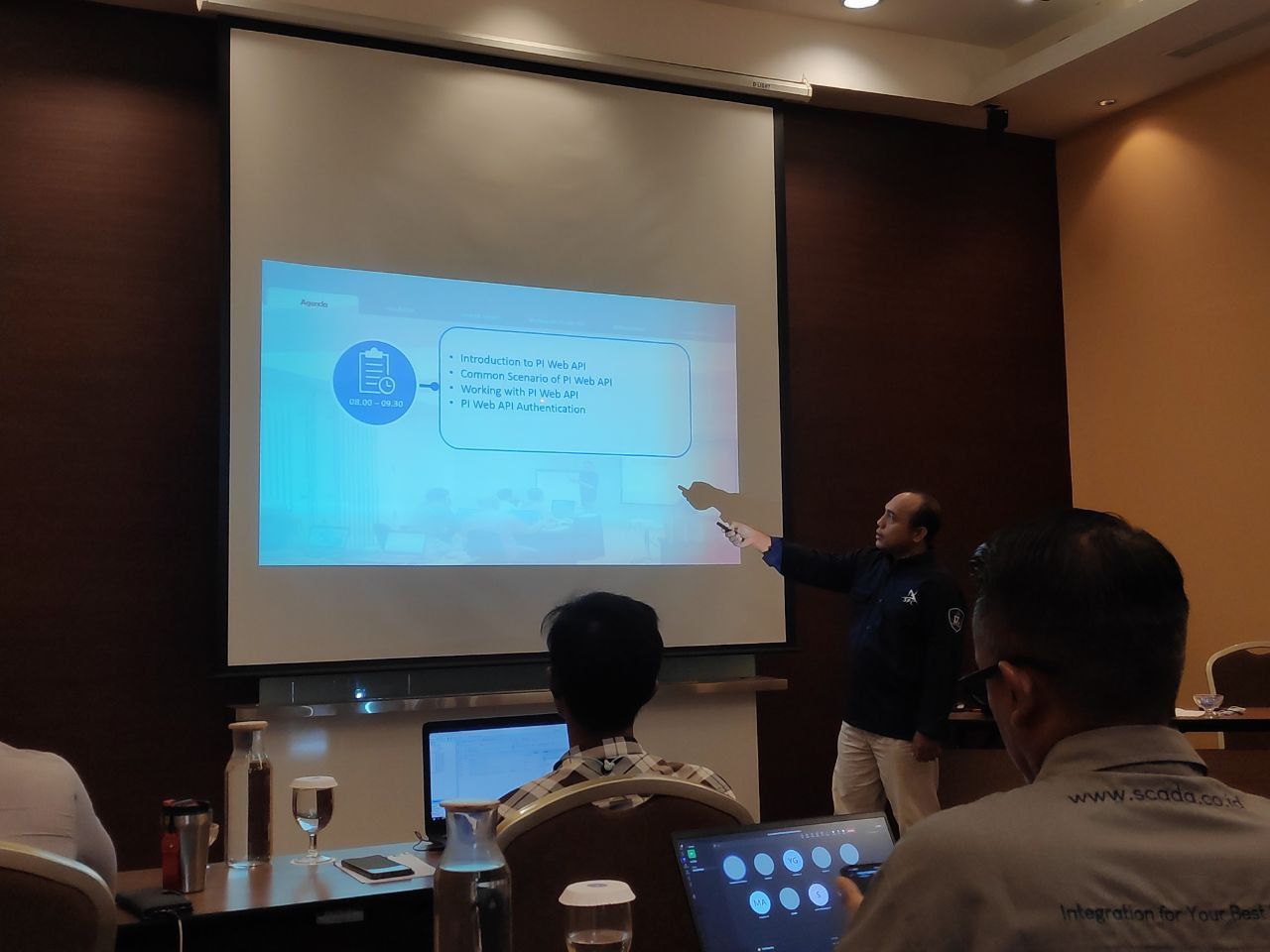
TRAINING PROGRAM
AVEVA PI System Training
From data infrastructure to visualisation and integration
Operational data only creates value when the right people can access it, understand it and trust it. Through our AVEVA PI System training programme, SPC helps engineering and IT/OT teams master the platform end to end — from the underlying infrastructure through to visualisation and cross-system integration.
The programme is built around practice. Participants do not merely learn the concepts; they configure a live PI System environment prepared for the class and work through each task themselves.
Training Scope
PI System Foundations
An introduction to the components and architecture of the PI System, including high availability, failover and the flow of data from field instruments through to end users. The session also covers system security principles and the routine maintenance that keeps the platform reliable.
PI Server Administration
Installation of PI Server, Asset Framework and PI Vision; collecting data from OPC sources through PI Interfaces and PI Connectors; managing tags in bulk; and using PI System Management Tools for monitoring, backup, tuning and resolving data issues such as stale and bad points. Buffering, PI to PI interfacing and archive restoration are also covered.
Asset Framework (AF)
Modelling assets using elements, attributes and templates; applying data references and units of measure; building analyses for calculation and alarm generation; working with event frames; and configuring automatic notifications. The module also covers asset security together with backup and restore of the AF database.
PI DataLink
Retrieving and processing PI data directly inside Microsoft Excel. Participants work with PI Time, calculated and time-filtered data functions, running hour and totalisation calculations, filter expressions, and the comparison of related events.
PI Vision
Designing informative operational displays using trends, tables, bar and gauge charts, the graphic library, multistate behaviour and navigation between displays. The module also covers collections and asset filters for typical equipment, event frame tables, display security, and migration from PI ProcessBook to PI Vision.
PI Vision Custom Symbols
Developing custom symbols for visualisation requirements that the standard library does not cover, including the extensibility concept, the deployment workflow, symbol configuration and troubleshooting.
PI Web API
Using the PI Web API as an integration path towards other applications, covering authentication, the controller structure and WebID, and the process of reading and writing PI data over REST.
PI Integrator for Business Analytics
Preparing asset views and publishing PI data to analytical targets such as Microsoft SQL Server, including user access configuration, as a bridge towards using operational data at business level.
PI CONNECT
An introduction to the PI CONNECT service: administration of users, groups and roles; real-time data synchronisation from an on-premise PI Server; exploring data through Asset Explorer and Trend; and distributing data outwards through the Power BI connector and the REST API.
Training Approach
The material is delivered through three complementary modes:
- Theory — establishing an understanding of the architecture and underlying concepts
- Demo — showing real workflows and use cases
- Hands-on Lab — direct practice by every participant
AVEVA PI SYSTEM TRAINING SERVICES (OFFLINE & ONLINE)
Building on our hands-on implementation experience, SPC extends its AVEVA PI System expertise into structured, practitioner-led training programs. Unlike generic vendor courseware, SPC's curriculum is built around real project experience — the same architecture decisions, configuration workflows, and troubleshooting methods our engineers apply in live industrial deployments. Training is delivered flexibly, either offline (on-site / classroom) or online (live virtual), so organizations can upskill teams regardless of location or site access constraints.
Delivery Formats
- Offline Training: On-site / classroom sessions at the client facility or an SPC training venue, using a live PI Server, AF, and PI Vision sandbox environment. Includes hands-on interface and network configuration labs — well suited to control room, instrumentation, and site engineering teams.
- Online Training: Live, instructor-led virtual sessions via video conferencing with remote access to a cloud-hosted PI sandbox environment, supplemented by recorded session playback and LMS-based reference materials. Well suited to multi-site organizations coordinating teams across a central office and remote field locations.
Who Should Attend
- Control room operators and SCADA/DCS engineers
- Instrumentation & control (I&C) engineers
- Reliability and maintenance engineers
- IT/OT infrastructure administrators
- Data analysts and data scientists supporting predictive maintenance programs
Training Syllabus — Modules & Case Study Focus
Each module combines instructor-led theory, hands-on lab exercises in a live PI environment, and a case study drawn directly from SPC's field deployments, closing with a short applied assessment.
Comprehensive Case Study: Turbo Machinery Analytics Deployment
A central thread running through the syllabus is a comprehensive, multi-module case study modeled on an actual Turbo Machinery Analytics System deployment for a gas transmission operator with remote compressor stations feeding a central monitoring facility. Trainees work through the same design trade-offs SPC's engineers faced on the project: consolidating turbine and metering data at the PLC layer rather than connecting directly into the control layer, structuring an ISO 14224-aligned asset hierarchy for compressors across multiple remote sites, sizing servers and infrastructure for OPC interfaces, PI AF, PI Vision, and a Machine Learning environment, and applying a structured, multi-layer approach to diagnosing operational reliability issues. This grounds every concept in decisions trainees are likely to face in their own facilities, rather than abstract, vendor-generic examples.
Program Options
Modules are available individually or as bundled tracks, and can be tailored to a client's specific PI System landscape and skill-level requirements:
- PI System Fundamentals — 2–3 days
- Intermediate Track (AF, Analytics & Event Frames) — 3 days
- PI Vision Dashboard Design — 2 days
- Digital Twin & Machine Learning Integration — 3 days
All programs conclude with an applied assessment and a Certificate of Completion issued by SPC. Offline sessions can be scheduled at client sites nationwide; online sessions run on a fixed cohort calendar or as a private group booking.
WHY SCADA PRIMA CIPTA (SPC)?
- Deep OT Domain Expertise: Proven hands-on experience across SCADA, DCS, PLC, and Historian systems in Indonesia's toughest industrial environments.
- Proven Track Record in Heavy Machinery: Specialized knowledge in complex rotating equipment analytics, bridging mechanical engineering concepts with data science.
- End-to-End Implementation: From hardware cabling and network interfaces to cloud/AI integration, SPC provides a single-point-of-accountability.
- Local Support & Agility: Dedicated local engineering team offering fast response times, on-site support, and tailored SLA agreements.
- Field-Tested Training Curriculum: Training delivered offline or online by the same engineers who design and implement PI System projects in the field, built around real deployment case studies rather than generic courseware.
Partner with PT Scada Prima Cipta
Unlock the full potential of your AVEVA PI System. Contact our specialist engineering team today for technical consultations, system audits, custom ML implementation proposals, or to schedule an offline or online AVEVA PI System training program.
Further Information
PT Scada Prima Cipta is ready to help design a training programme that matches the condition of your system and the objectives of your team. Please contact us to discuss your PI System training requirements.